


Prepared By:
Shannon Lowery
Travel Content Creator
10-Day Dolomites Itinerary without a Car
Start / End
Cortina d’Ampezzo / Bolzano (general area)
Suggested Days
At least 10
Suggested Seasons
Summer, Early Fall
#UnfollowtheCrowd
10 Days in the Dolomites: From Cortina d’Ampezzo to Bolzano & Beyond
Doubters will say a 10-day Dolomites itinerary without a car simply isn’t possible without cutting corners, but I’m here to say from personal experience, yes it is. Enjoy it all, from hut to hut hiking to resort-style relaxation, during this two-part trip to the Dolomites which I’ve already taken on a test run for you. (You’re welcome!) The adventure kicks off in Cortina d’Ampezzo, host of the 2026 winter Olympics, and head west where the mountain magic continues to unfold. From where to stay to how to get around, this 10 day Dolomites itinerary has it all to help you get started planning your dream mountain escape. Consider this your personal invitation to use the information below as a template to build your own custom adventure based on your interests and budget.
Planning Your Dolomites Itinerary
When planning any trip to the Dolomites, it’s important to ask yourself a few important questions first.
1. When will you be traveling? We knew we wanted to travel in September, when the summer crowds die down but before many rifugios and lifts close for the winter preseason in October/November.
2. How long do you have? We had to keep our trip under two weeks, making 10 days the perfect length to include a little extra wiggle room.
3. What’s your budget? We wanted to strike a balance between spend and splurge, which is where the inspiration for this two-part itinerary, primarily divided based on price point, will be insightful for fellow travelers.
4. What activities are you most interested in? We wanted to hike and relax, which are the main features of this itinerary. If you want to mountain bike, paraglide, do a via ferrata, or any other specific activity, build it into your trip during the early planning stages. Day-of bookings for special activities are risky.
Some answers to these questions may also affect where you fly in/out of, which could also impact your route. Remember that just because the Alta Via 1 is one of the most popular hiking routes in the Dolomites doesn’t mean it’s the only way to go. Be open to building your own journey to help you make the most of your time.
Be sure to check out this 5-Day Hiking Itinerary which provides a shorter alternative circular route in the heart of South Tyrol, as well as our complete guide to hut-to-hut hiking in the Dolomites. The Alta Via 1 is one of the most popular thru-hiking routes in the Dolomites, thus the most highly trafficked with more competition for accomodations. We encourage you to look beyond that route though, as it really is possible to build your own custom itinerary like this one using little more than trusted resources and research.
What You’ll Need
A Dolomiti Superski Pass
“Do I really need a Dolomiti Superski Pass? Can’t I just hike up and down?”
For the purposes of this itinerary, yes you need a Dolomiti Superski pass. For custom itineraries, whether or not you need a Dolomiti Superski Pass is a personal decision to make. For us, this was my first multi day hiking trip. Considering it was my first time hiking with an overnight pack and knowing how much distance we needed to cover, I knew that given the option I would always prefer to ride a lift rather than hike.
“How much is the Dolomiti Superski Pass?”
There are several pricing options for summer Dolomiti Superski Passes. We estimated we’d take at least one if not multiple lifts every day, so we opted for a multi-day pass. For less than 200 euros, we had unlimited access to all open lifts, gondolas, and cable cars in the Dolomiti Superski territory within a five-day window. No messing payment at the gondola huts–just tap and go!
“Can I pay per lift?”
You can pay per lift, but beware lift prices vary. Some, like the Cortina Skylift, can be upwards of 50 euros. If you plan on riding even just a few lifts, the Dolomiti Superski Pass is the way to go.
Other Resources & Items
A Bus Pass. Many accommodations will include a free public transit guest pass, which is not available for purchase. Check participation here. There is also a handy SudTyrol Mobile Pass, as well as an app where you can explore options. You can also pay the driver directly with a card and sometimes cash.
A Good Navigation App. Sort your maps and hiking routes before you arrive in the Dolomites, including downloading all of your routes and getting them marked on a paper map when you get to the region. AllTrails and Outdoor Active are popular with locals. There’s also a Dolomiti Supersummer app for making the most of summer activities in the Dolomites.
Part 1: Hut-to-Hut Hiking from Cortina to Val Gardena
Prepare to embrace your inner expeditionist. The first half of this 10-day summer Dolomites itinerary is an independent hut-to-hut hiking experience starting in Cortina d’Ampezzo and ending in Val Gardena. The route intersects the Alta Via 1 on the first day before branching off on a custom trek through the heart of the Dolomites. This part of the trip is minimalist, budget-friendly, and rugged.
DAY 1: ARRIVE IN CORTINA D'AMPEZZO
To begin our 10-day Dolomites trip, we flew into Venice and took the Cortina Express bus straight to the mountains. For just €25/$29, it’s an affordable and surprisingly fast way to go from the airport to alpine paradise in just a few hours.
We disembarked in Cortina D’ampezzo, an adorable town of 5-6,000 permanent residents with great shopping, lively terrazzas and wine bars, and plenty of accommodation options at every price point. (We stayed at the Hotel Regina, which was wonderful.) If you forgot anything or need to stock up on supplies, there are several gear shops in town.
Winter Olympics in Cortina
Fun fact: Cortina is hosting the 2026 Winter Olympics, so there’s a buzz of development and excitement in the air. Infrastructure will be repurposed after the games to add even more access and amenities to the area.
DAY 2: CINQUE TORRI & PASSO FALZAREGO
Our first morning in the Dolomites, we stocked up on picnic lunch supplies and set off on our ascent toward Passo Falzarego. It was a fully uphill day but mostly passed through shaded forest trails.
When we reached Cinque Torri, we hopped on our first chairlift of the trip to the top. I actually had never ridden a chair lift before, so this was a very fun and slightly scary experience for me. Little did I know it would become the first of many and I’d be a lift pro by the end of this trip! Anyways, when we reached the summit, we were met with our first fully panoramic view of the trip with incredible rocky peaks and formations wowing us in all directions. It was one of those rare vistas that didn’t even look real. Back at the bottom of the lift, we hiked another mile or so west to Passo Falzarego, where we rode the lift up to Rifugio Lagazuoi for an aperitivo and some more fabulous views.
Booking Mountain Huts & Rifugios in the Dolomites
We originally wanted to stay at Rifugio Lagazuoi—the place looked very well-equipped and the location was perfect—but it was fully booked when we were planning the trip. (Those pesky Alta Via 1 hikers!) We ended up at Col Gallina, a smaller, more basic accommodation at the bottom of the lift. It got the job done, but book your preferred rifugios early. For reference, we traveled in mid-September and booked our hut accomodations six months in advance.
DAY 3: ALTA BADIA
On our second day of hiking, we got up early and headed out right after breakfast. The rifugios make it pretty clear that if you’re checking out, you need to get moving. We started picking our way through Passo Valparola where the trail weaves between old WWI bunker ruins. We also spotted some local military groups doing rock climbing and mountain rescue training on the cliffs here.
When we got to Rifugio Passo Valparola, the trail basically disappeared despite what the map said. We didn’t want to walk on the road, so we pushed downhill through brush and boggy grazing pastures. It’s in this section that you cross from the Veneto region into Trentino-South Tyrol. Eventually we intersected with an actual trail and followed that all the way down to Armentarola, then continued on to St. Kassian and the Alta Badia region.
At this point we were starving and grabbed picnic lunch supplies from a local grocery store in St. Kassian. You should know that many shops, including grocery stores, close for an hour every day at lunchtime in this region.
Why We Love the Lifts in the Dolomites
From St. Kassian, we took the Piz Sorega lift up to the Piz la Ila area. Originally, we had mapped a hiking route around the base of the mountain. Thanks to our handy lift passes, though, we discovered we could take a shortcut by using a series of lifts up and over the alpine plateau rather than around it. Not only did it shave off some mileage, it was really fun and interesting! After all, some of the best views in the Dolomites are from the lifts themselves. Hiking purists may consider this method cheating, but we felt we were getting in PLENTY of steps otherwise, especially with our packs, and were happy to break things up.
Words can’t describe the views from atop Piz la Ila. Also, there’s an extensive mountain bike park, several large upscale rifugios, children’s play parks, and more. With a little bit of everything, it’s clearly a great place to stay for families. This mountain park area is accessible from all different directions and the lifts are mountain bike and dog-friendly! With cows grazing freely and paragliders sailing through the sky it was a very idyllic Dolomites scene. After taking a sequence of lifts we ended up down in the town of Corvara, where we stayed the night.
“What happens if I don’t make it to my hut?”
This actually happened to us! On this second day, we were supposed to continue from Corvara to Rifugio Pisciadu. Even though we left early, kept a good pace, and took a shortcut, we still didn’t reach Corvara until the late afternoon. To hike to our rifugio, it was going to be another three or four hour hike with 1,000+ meters of elevation gain. We were already tired from a long day but were initially committed to pushing through.
The part that truly made us turn around was that it was very unclear if the trail was a via ferrata or not. Even though we tried filtering routes to exclude via ferratas on the map, as we didn’t have the experience or equipment, this route was still displayed. However on approach, there was a lot of signage about not proceeding without proper equipment. We asked a local coming down the trail and he confirmed that it was a challenging trail that *could* be done without equipment by brave hikers. “There’s a cable you can hang onto in the very deep parts,” he said, looking suspiciously at our packs and lack of gear. It was getting dark in a few hours, so we called it. No one (me) wanted to have a sunset panic attack on a rocky ledge once it was too far to turn back.
Hotels in Corvara, Alta Badia
Thus we backtracked to Corvara to find a place for the night. Because it was a sizable town, we were fairly confident we would be able to find a place to stay and a quick Google search revealed promising availability. As it turns out, most places that allow for single night stays are also some of the most expensive. So we splurged on a gorgeous room at the ultra chic Hotel Marmolada, which cost us a few hundred euros but not our lives. Money well spent if you ask me.
DAY 4: COFFIN GONDOLAS & SASSOLUNGO-LANGKOFEL
We departed Corvara in the morning on a bus headed for Plan de Gralba, where we could pick back up on our route on the other side of Piz Boé. Bus passes are included with hotel and resort stays (not rifugios, unfortunately), which soothed some of the sting of our unexpected expense. If you don’t have a pass, you can pay cash or credit card—rides generally aren’t more than a few euros.
Pro tip: if you’re prone to motion sickness and plan on using the bus, pack Dramamine. The winding mountain roads in the Dolomites are gnarly and bouncing along on a bus doesn’t make it any better.
Forcella Sassolungo – the Coffin Gondolas
From Plan de Gralba, we took the you cut up through the mountain bike park and around the southeastern corner of the Sassolungo rock formation on a lovely partially-wooded trail. Finally, we arrived at the “coffin gondola” at Forcella Sassolungo, a lift with 1950s-era compartments just big enough for one or two people. They’re narrow by design to combat the strong winds of the mountain pass. The reward for the adrenaline-fueled ride were epic views of the surrounding valley. We got lucky and spotted people clambering over the via ferratas at the top, which was wild to see at eye level on top of a mountain.
Back at the base of the gondola, we had a tasty lunch on one of the upscale hotel terraces, then continued wrapping around the mountain toward Sasso Piatto (Plattkofelhütte). This section of trail was incredible—sweeping views of the valley to the left and not too rigorous, though you’re still gaining a bit of elevation.
In about two hours, we reached the mountain hut at Sasso Piatto, which seemed really new and had lovely rooms. There was only one shower, but it’s on a timer so everyone gets through pretty quickly with a little patience. The food here was rich and hearty and the portions were generous. This family-run hut is also an active livestock farm, so you’ll fall asleep to a symphony of clanging cowbells, chirping marmots, herding dogs barking in the distance, and the occasional horse neigh.
DAY 5: SEISER ALM-ALPE DI SIUSI & SECEDA
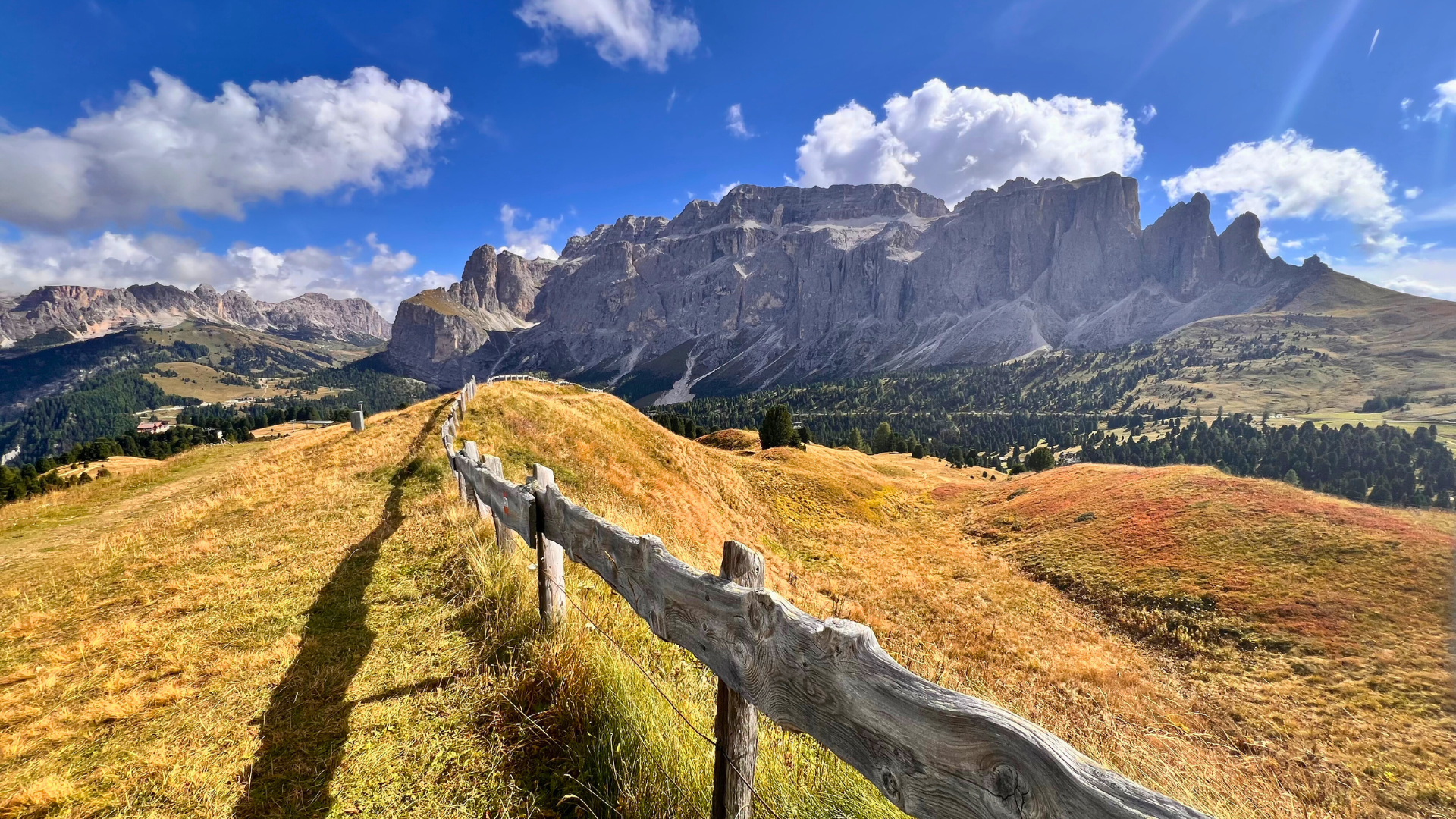
On day five, we hiked down the edge of Seiser Alm-Alpe di Siusi toward Santa Cristina with views of Seceda in the distance the whole way. This section of the route, a gravel access road rather than technical trails, was sweeping views of quintessential farm huts overlooking lush meadows. We hopped on the lift at Monte Pana which whisked down into the village in the valley.
Cable Car to Seceda
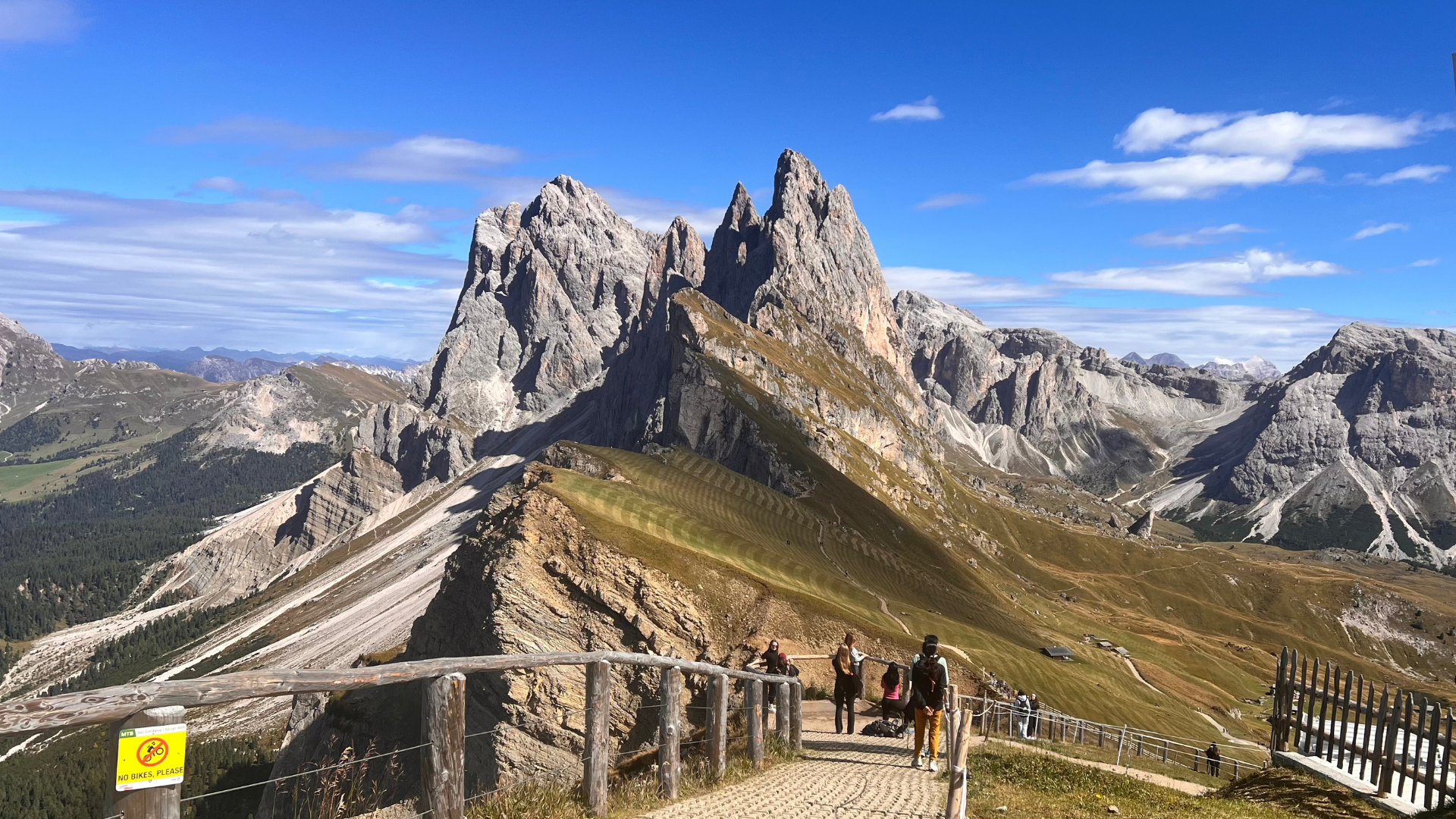
Once in Santa Cristina, we grabbed some picnic supplies at a grocery store and headed to the Col Raiser lift. The short but steep walk to the lift was puffy enough alone, so I was very grateful to once again avail our lift passes. Once at the top, we crossed the alpine meadow and took another lift up to the actual peak of the iconic Seceda ridgeline. Everyone comes here to see the famous slanted edge of Seceda—an extraordinary angle of landscape—but honestly, the real beauty is in the view of the Dolomites to the south. Though windy and a bit chilly, it was one of the most scenic lunches of my life.
Afterward, we enjoyed a beer at the Almhotel Col Raiser before descending back into town. The Almohotel looked inviting and would be a fantastic place to stay the night, but we had other plans back down in Santa Cristina.
Part 2: Luxury Hotels & Resorts in the Dolomites
This is where our itinerary shifts from a hut to hut backpacking excursion to a luxury resort vacation. For time’s sake, we recommend you pick one or two of these unique luxury hotels to round out the rest of your 10-day Dolomites itinerary. If you’re able to stretch your trip longer, spend at least a few days at them all! Each has its own distinct appeal and all of them are family-owned-and-operated by hands-on management ready to pamper you from head to toe!
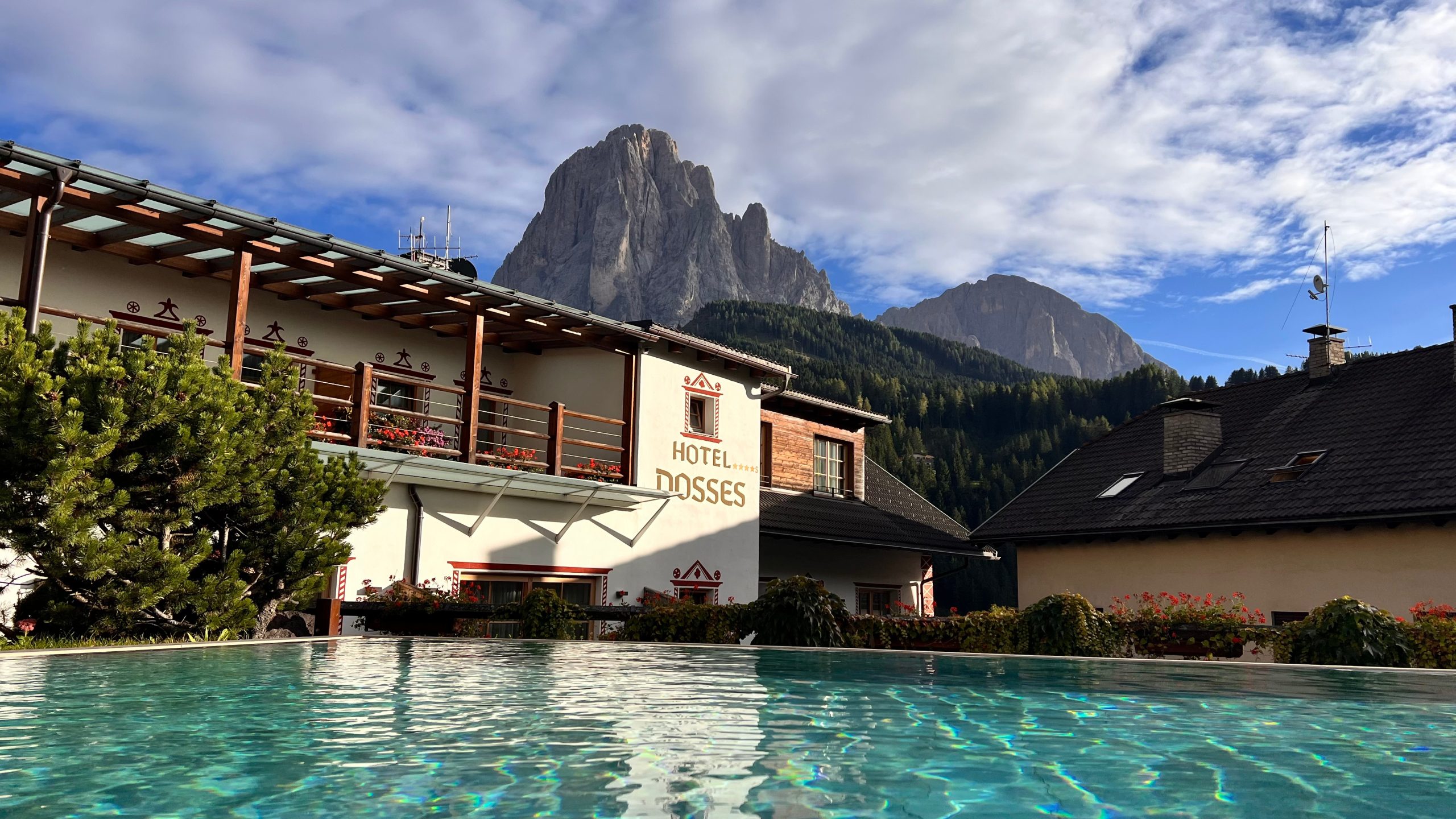
VITALHOTEL DOSSES, SANTA CRISTINA
Year round, this is the most expedient gateway to the mountain trails and ski slopes, located just steps from your doorstep. In the summer months, enjoy the hotel’s own guided hiking and mountain biking excursions in the surrounding valley. In winter, take your pick of the surrounding ski lifts, ascending the slopes in all directions. After a long day of adventures, the heated pool welcomes swimmers, while the newly redesigned sauna complex spares no spa experience, with dry saunas, steam rooms, an ice room, and a bracing mountain spring deluge.
And don’t forget to pack your alpine appetite. Dinner is a generous spread of traditional Tyrolean favorites, including locally-sourced foods and herbs from the kitchen garden just across the street. Sip a nightcap in one of the hotel’s many cozy corners like the lobby stubbe or the study just off the bar. VitalHotel Dosses is the choice for those who want the welcoming embrace of a mountain village and the comfort of a luxury accommodation.
The highlight of our stay: enjoying an evening aperitivo on the front terrace while the most spectacular sunset reflected on the Sassolungo rock formation overlooking Santa Cristina.
HOTEL PFÖSL, NOVA PONENTE
If it’s starting to sound like a car is pointless even here, that’s by design. This is green luxury in its truest form—where everything has been thought of for you with sustainable solutions in mind. Challenge yourself to see how far you can unplug (you can even temporarily disable the WiFi in your room with just the push of a button.) Whether you choose the main lodge or opt for the privacy of a separate chalet, the surprisingly modern architecture maintains a natural warmth with floor-to-ceiling windows putting the surrounding peaks on full display.
The property’s Regeneration 360 theme is more than a concept, it’s a tangible part of the Pfosl. In the spirit of holistic wellness, guests are invited to try planned activities like hikes, yoga and meditation sessions, and bread-baking classes, to connect mind, body and soul. The extensive sauna circuit, with plans for even more expansion, walks guests through an experience where room after room presents a new interpretation of relaxation. Major highlights include the indoor-outdoor heated saltwater infinity pool and the mountain spring cold plunge.
And while some sections of the sauna are strictly adults-only, the lodge is surprisingly kid-friendly, with dedicated play rooms and spaces that encourage little imaginations. Between pastures and playgrounds, activities and restfulness, both curiosity and calm blossom amongst guests of all ages.
The highlight of our stay: the evening charcuterie hour featuring the bread baked by guests using the 300-year-old stone oven during a special weekly session.
ANSITZ STEINBOCK, VILLANDERS
Unlike the accommodations above, which are designed for long-term stays and specifically appeal to skiers, the Ansitz Steinbock is a short-stay accommodation that provides an entirely different experience and set of amenities. Perched in the hilltop village of Villanders, the Ansitz Steinbock occupies a 15th century manor which was once home to wealthy aristocrats. In more recent history, a locally-loved restaurant and tavern remained on the site with basic rooms for rent upstairs. That all changed when the current owner took over less than 20 years ago and gave the property a major facelift, restoring it back to its former glory and then some.
Today, twelve exquisitely designed rooms, each with its own private in-room sauna, provide guests with a true home away from home. But despite the quiet grandeur of the aesthetics, the culinary footprint is still the foundation of the experience at the Steinbock. Elegant breakfasts and dinners are served in the two original stubbes, as well a private wine cellar and a fine dining experience, all led by a rising star head chef who hails from the region.
Guests can arrange tours with local winemakers, wander the winding lanes of the nearby village of Klausen-Chiusa, and receive private cooking lessons at the owner’s family mountain hut overlooking Alpe de Villanders. If you’re looking for a hyper-local, leisurely, and low-key escape in a boutique accommodation, Ansitz Steinbock sets the standard for a premium experience.
This all-encompassing 10-day Dolomites itinerary is perfect for summer or early fall and includes everything from budget hut-to-hut hiking to opulent resort indulgences. From Cortina d’Apezzo to Val Gardena, Bolzano and beyond, taste the finest wines and local dishes of the region, learn about the fascinating history of the area, and take in views that linger long after you’ve returned home.
Recently Explored/View All
Family Resort Rainer: An Alpine Getaway for the Whole Family
Beneath the jagged limestone towers of the Italian Dolomites in the lush Sexten Valley, adventuro...
Helen, Georgia: the Outdoor Adventure Capital of the Peach State
Surrounded by rolling Appalachian Mountains with easy access to metropolitan hubs like Atlanta, C...
Family Vacation Meets Luxury at ULRICHSHOF Kinder Hotel
Built by parents, for parents, ULRICHSHOF Family Hotel in the Bavarian Forest is a one-of-a-kind ...

Top Things to Do in Augusta, Georgia
Every spring, Augusta, Georgia, takes the global stage as the host of the annual Masters golf tou...
Winslow, Arizona Uncovered: A Closer Look at Route 66’s Iconic Town
More than just a Route 66 photo stop, Winslow, Arizona pulses with history, art, and community li...
From Phoenix to Tucson (the Scenic Route): Discover the Hidden Gems of Arizona’s Copper Corridor
If you’re anything like us, you probably chase the kind of off-the-beaten-path places that usua...
Where to Go Between Phoenix and Tucson: 3-Day Copper Corridor Itinerary
If you’re craving a trip with equal parts desert adventure, small-town charm, and genuine Arizo...
4 Days in Superior: Arizona’s Historic Copper Mining Hub
Long before Arizona became famous for Grand Canyon National Park, spring getaways, and world-clas...
Write Your Own Southwest Story in Superior, Arizona
Arizona is world-famous for its many highlights: Grand Canyon National Park, a thriving internati...
Village Trails, Coral Reefs & Island Mornings: A Journey Through Fiji’s Heart
Journey into the heart of Fiji, where village trails, vibrant coral reefs, and slow island mornin...
Donegal, Ireland | Guide to the Forgotten County
Rural. Remote. Exposed. Forgotten. All words used to describe Donegal by locals themselves. As a ...
Yes, Your Epic Pass Works in Switzerland: Here’s How to Ski Crans-Montana This Season
Sure, it’s farther than your usual weekend getaway, but Crans-Montana is absolutely worth the e...